Man in the elements

The year 2011 marks both the 20th anniversary of the death of the Swiss author Max Frisch, on 4 April 1991, and the 100th anniversary of his birth, on 15 May 1911. I only discovered this by chance when I recently read his beautiful novella Man in the Holocene, published in German in 1979 and in an English translation by Geoffrey Skelton in 1980.

The misleading cover of Max Frisch's Man in the Holocene (Champaign: Dalkey Archive , 2007).

The Dalkey Archive edition has a misleading picture on the cover: this is not a book about a young man or woman walking or jogging in a flat and misty landscape under a huge milky whitish sky.

Posted in Max Frisch | Tagged , | Leave a comment

Letter to Mister H. (or Mister H. Learns To Drive)

Dear Mister H.,

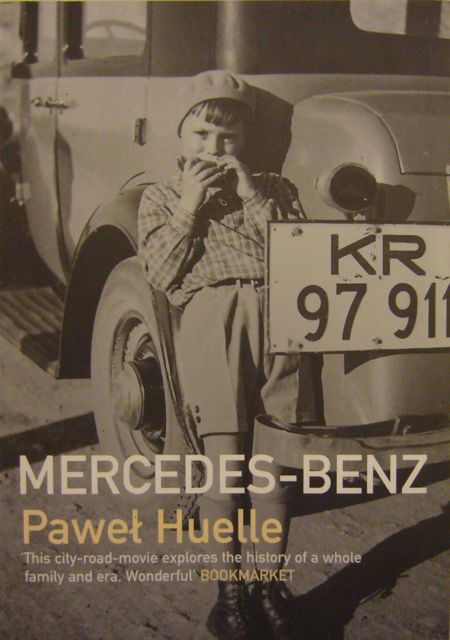
I’ve just finished reading your short but dense novel Mercedes-Benz – in the English translation by Antonia Lloyd-Jones, of course, since I don’t know a word of Polish. Indeed, yours is one of the very few Polish novels I’ve ever read. And I’m grateful to Serpent’s Tail, your British publisher, for doing what they do, which is bringing foreign-language books to our attention, since there aren’t really enough of them on the market.
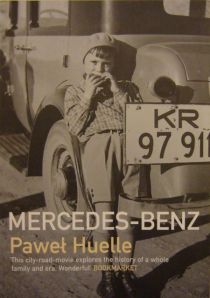
Cover of Pawel Huelle's Mercedes-Benz (London: Serpent's Tail, 2005).

If I understand correctly, Mercedes-Benz is part of a series of Letters to Hrabal, and indeed, I often thought while reading it that it is in fact a love letter of sorts to Hrabal, whose storytelling powers your narrator, “Mister H.”, is so fond of and whose death in early 1997 leads him to dig up his family photographs and start writing.

Mister H. is a storyteller himself, of course, spinning his yarns for his driving instructor, Miss Ciwle, a Hrabal fan herself, as they make their way through the Gdansk of the early nineties in her Fiat 500. I liked the way you manage to give us a glimpse of Polish history as they drive through the city. The names of the streets and landmarks alone give us a good idea of the country’s tumultuous past: from Napoleonic forts to Warsaw Insurgents Street, from Prussian barracks to the Soviet T-34 tank being removed from Crab Market.

I also liked the way you evoke your country’s history through the tales Mister H. tells Miss Ciwle about the family’s history of cars, from grandmother Maria’s Citroën in the twenties to the series of Mercedes that followed – a history that came to an end in the early seventies, when an official from the Department of Aesthetics tells Mister H.’s father to get rid of his old and rotting Mercedes since “the sight of it was having a bad effect on local well-being”.

From the book under discussion.

But if truth be told, I found the humour rather weak. It’s too often filmic, almost cartoonish: stalling in heavy traffic and on a railway crossing, getting tangled in the seat belt, hitting the accelerator instead of the brake and crashing into a bin, etc. I guess it’s just intended as light-hearted comedy, but wouldn’t you agree that we’ve all seen these scenes a thousand times before and that the comedy itself sometimes stalls?

Of course, Mister H. is a melancholy type of fellow who believes he was born too late, and perhaps he would have loved to find himself in a black-and-white comedy. He has little love for the present, in any case, which he sees, perhaps rightly so, as some kind of corrupt capitalist inferno (and you certainly seem to voice your dislike of contemporary art in that strange digression on Physic’s adventures on the Californian art scene: I mean, where does that fit in?).

If Mister H. isn’t at home in the present, maybe that’s why he’s so attached to his collection of family photographs, and feels “truly disinherited” when he believes he’s lost them. But he finds them in the end, and it’s only after he’s dug up these pictures that he starts writing, and it’s these pictures you include in the novel. I don’t know whether they add all that much to your work, and I’m not sure they work well with the at times erratic tone of the text, as it moves from light comedy to angry rant to more somber melancholy. Still, I found the four featuring members of your family to be the best: not moving, but tender.

From the book under discussion.

Of course, though he didn’t lose the photographs, Mister H. does lose Miss Ciwle – and if you ask me, it serves him right. I mean, if he was so fond of her, why didn’t he sleep with her? All this talk about them being “fraternal souls” because they both like Hrabal and like to smoke pot in silence. What? Should that prevent them from sleeping together? Whether he does so intentionally or not, he certainly seduces her with his stories, but fails to seduce her in the flesh. Why is that? I think he doesn’t really love her, but ultimately seems to pity her. The more I learned about her – her past as a stripper who had to sleep with the head of the driving school to get a job and a car, her handicapped brother she has to take care of, the mean and corrupt doctor who treats her brother, the shed she and her brother live in next to a cemetery, and, the last straw, the fact that the shed has been levelled to make way for a building project at the end of the novel – the more I thought that the only narrative response to this was not to lapse into silence as Mister H. does repeatedly, but to laugh. Surely the accumulation of so much ill fortune on a single character is funny in itself, no?

Anyway, this is where I get off, so thanks for the ride, and bonne route.

Yours etc.

Posted in Pawel Huelle, Picture novels | Tagged , , , , | Leave a comment

Swayed by endorsements – one way, or another

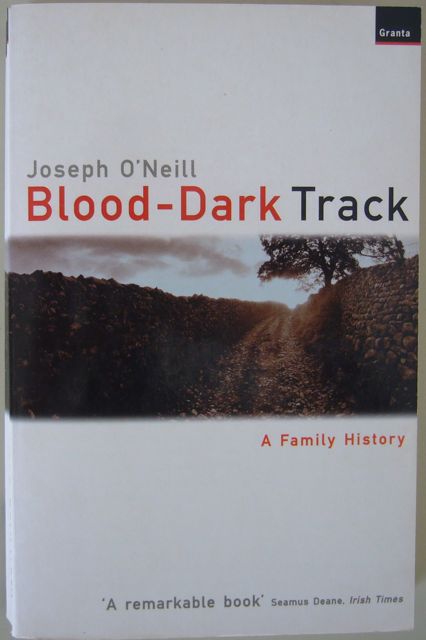
I picked up a copy of Joseph O’Neill’s Blood-Dark Track: A Family History (2001) in early 2007. But I really can’t tell you why. I don’t mean that I regret buying it, far from it, but I really don’t know why I chose that book, and not another. Of the dozens, the hundreds, the thousands of books to choose from, why, at bottom, do we choose certain books?

Front cover of Joseph O'Neill's Blood-Dark Track, with a quote from Seamus Deane (London: Granta, 2002).

Perhaps I had chosen O’Neill’s book because of the great title (which turned out to be from Yeats’ “Hound Voice”). Perhaps it was because I have relatives called O’Neill and I felt some kind of connection. Perhaps it was because the quote on the front cover – “A remarkable book” – was from Seamus Deane, writing in the Irish Times. I had read and enjoyed Deane’s Reading in the Dark, and if he found it remarkable, perhaps I would, too.

And indeed, I did, so much so that when O’Neill’s Netherland came out to rave reviews in 2008, I wanted to get a copy. The edition I came across, however, featured an endorsement from Jonathan Safran Foer on the front cover, just beneath the title: “Netherland“, Foer claimed, “is suspenseful, artful, psychologically pitch-perfect, and a wonderful read.” Seeing that, I could not bring myself to buy it. Childish as it may sound, I just did not want a copy with an endorsement on the front cover from Foer.

The book I didn't buy: Joseph O'Neill's Netherland, with a quote from Jonathan Safarn Foer on the front cover.

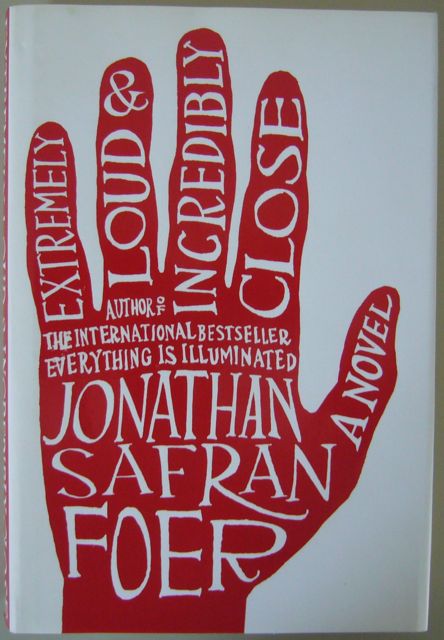
Why not? Because my interest in novels with pictures in them had led me to read Foer’s Extremely Loud and Incredibly Close when it came out in 2005. And suffice it to say that I did not like the novel. If the guy can’t write, I thought, rightly or wrongly, he probably isn’t much of a reader either.

Extremely Loud and Incredibly Close, too, had come with an endorsement, from Salman Rushdie. Luckily, it featured at the bottom of the front flap of the dust jacket and so wasn’t in plain sight. It reads: “Pyrotechnic, riddling and, above all, extremely moving. An exceptional achievement.” Having read the book, here, too, suffice it to say that I am not in any rush to purchase books endorsed by Salman Rushdie.

Jonathan Safran Foer's Extremely Loud and Incredibly Close, with an endorsement not seen here from Salman Rushdie on the front flap (London: Hamish Hamilton, 2005).

In the end, I eventually ended up getting another edition of O’Neill’s Blood-Dark Track, one with a quote from The Observer on the front cover. This didn’t mean that I had escaped Foer’s endorsement, however, which was tucked in among no less than ten other quotes on the back cover. So be it…

Back cover of Joseph O'Neill's Netherland, with endorsement by Jonathan Safran Foer, among others (London: Fourth Estate, 2008).

Posted in Jonathan Safran Foer, Joseph O'Neill, Uncategorized | Tagged , , | Leave a comment

Changing landscapes: Sebald, Parkman, Blackbourn

There is a passage in W.G. Sebald’s Vertigo in which the narrator regrets the loss of the beautiful view he had once enjoyed from Burg Greifenstein onto the Danube : “A dam has been built below the castle. The course of the river was straightened, and the sad sight of it now will soon extinguish the memory of what it once was”. Sebald includes two photographs in this passage, the first, a darkish picture of the view from the Burg taken in the late sixties or during his visit in 1980 with Ernst Herbeck,  the second at some point after the river had been dammed. Both photographs are printed on facing pages in this German edition of Vertigo.

Two views from Burg Greifenstein in W.G. Sebald's Schwindel. Gefühle. (Frankfurt: Fischer, 1996).

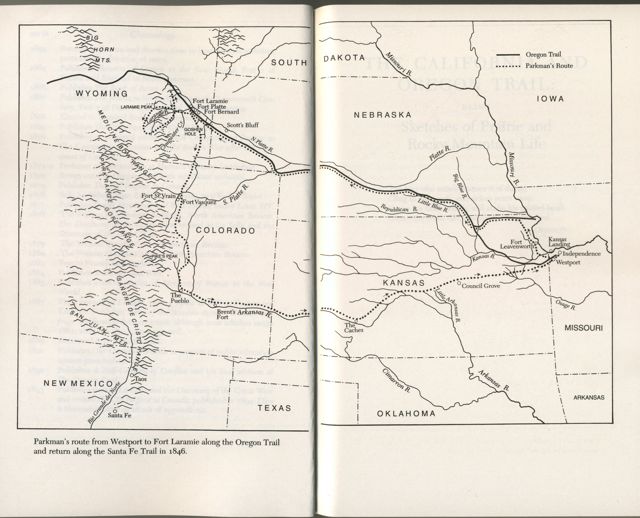
I was reminded of this passage recently when reading The Oregon Trail (the 1849 text edited by Bernard Rosenthal for Oxford UP), Francis Parkman’s remarkable account of his journey west through Kansas, Nebraska, Wyoming and Colorado as he pursued “some inquiries relative to the character and usages of the remote Indian nations”.

Map of Parkman's journey in the Oxford World's Classics edition of The Oregon Trail (Oxford: Oxford UP, 1996).

To reach Independence, their starting point on the western border of Missouri, Parkman and his companions first travelled by steamship from St Louis aboard the Radnor on 28 April: the boat “struggled upward for seven or eight days against the rapid current of the Missouri”, Parkman writes, “grating upon snags, and hanging for two or three hours at a time upon sand-bars”, and a bit further:

The Missouri is constantly changing its course; wearing away its banks on one side, while it forms new ones on the other. Its channel is shifting continually. Islands are formed, and then washed away; and while the old forests on one side are undermined and swept off, a young growth springs up from the new soil on the other.

The return journey, Parkman writes at the end of the book, was no quicker: it took “eight days, during about a third of which we were fast aground on sand-bars.”

Parkman’s journey took place in 1846. Since then, of course, things have changed. The Missouri was dammed extensively over the course of the twentieth century: according to the Wikipedia article, there are now 15 dams on the river. So it’s fair to say that it mustn’t look anything like it did in Parkman’s day. But is this something to be regretted and lamented? I don’t know.

Cover of David Blackbourn's The Conquest of Nature (London: Pimlico, 2007).

The Conquest of Nature: Water, Landscape and the Making of Modern Germany (2006) is David Blackbourn’s fascinating account of how Germans have altered their landscape over the past 250 years “by reclaiming marsh and fen, draining moors, straightening rivers and building dams”. From Frederick the Great’s vast land-reclamation projects in the mid-eighteenth century to the rise of the ecological movement after the Second World War, Blackbourn considers the various technological, practical, aesthetic, economic, political and racial considerations involved in these “wars” waged by mankind against “nature”.

Blackbourn is neither a pessimist nor an optimist in this matter: he neither idealizes the past nor glorifies the present. On the contrary, he invites us to entertain two contradictory ideas in our heads, the real gains and losses brought about by man-made changes to the landscape. As he makes clear, we basically don’t know what consequences these changes will ultimately have: as he says: “All history is the history of unintended consequences, but that is especially true when we are trying to untangle humanity’s relationship with the natural environment”, and it is these unintended consequences “that have to be summoned by an effort of the imagination, the possible future costs that have to be set against the confident promises of the present”. This is one of the things that make this a remarkable book and a pleasure to read, one of those books that makes us slightly less ignorant than we were.

It is sometimes nice, of course, to think, like Sebald’s narrator seems to, that it would be best to leave “nature” alone, that man’s interference in “nature” can only result in destruction and, above all, in ugliness. But who knows what the river looked like before Sebald saw it in the sixties? And who knows what it would have looked like had the dam not been built?

Posted in David Blackbourn, Francis Parkman Jr., W.G. Sebald | Tagged , , , , , | 1 Comment

Philip Roth, before he became Philip Roth

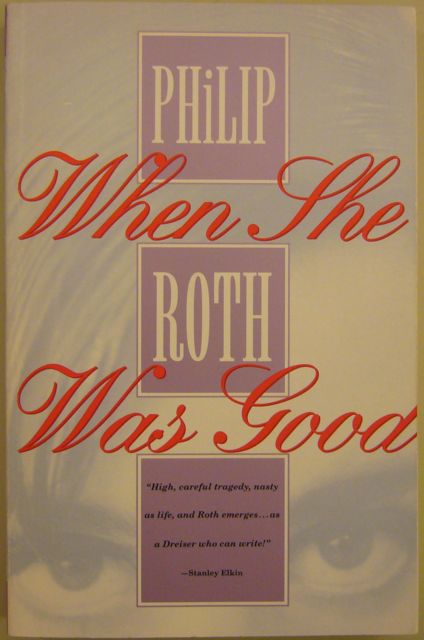
I first read Philip Roth’s second novel, When She Was Good, in March 2000 in this Vintage International paperback edition.

Cover of Philip Roth's When She Was Good in the Vintage International edition (New York: Random House, 1995).

It was originally published in 1967 – five years after his first novel, Letting Go (1962). Neither of these books have any of the lightness and humour that can be found in his debut collection, Goodbye, Columbus, and Five Short Stories (1959). Indeed, having won the National Book Award for that collection in 1960, Roth set out to show the world that he was a “serious” writer who would write “serious” novels. When She Was Good is indeed a “serious” novel, overly so.

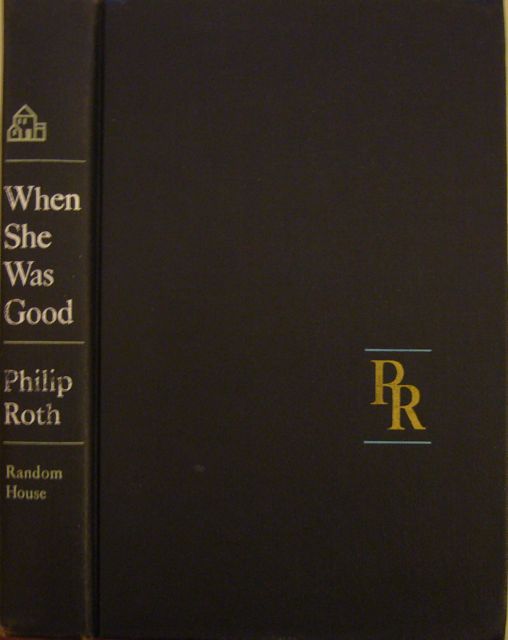
A while ago I came across a 1967 hardback edition of the novel, published by Random House. The dust jacket was missing, but the book was cheap and in good condition.

Spine and front cover of a 1967 Random House edition of Philip Roth's When She Was Good (New York: Random House, 1967).

Having bought it, I thought I might reread it – why not, after an 11-year gap? But after reading the opening sentence again – “Not to be rich, not to be famous, not to be mighty, not even to be happy, but to be civilized – that was the dream of his life” – I decided I might wait a while longer.

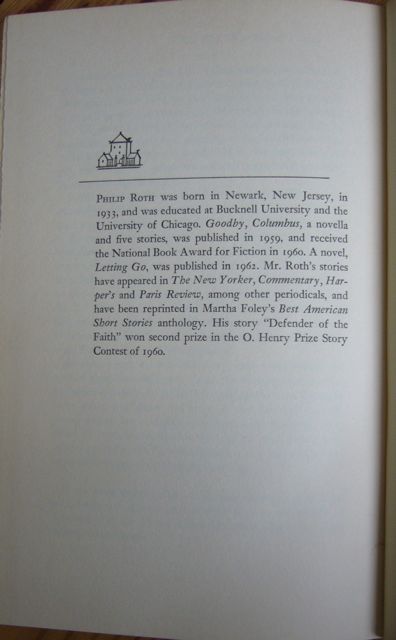
What caught my eye, however, was the short biographical notice at the end of the book, which informs us that Roth was “born in Newark, New Jersey, in 1933”, that he was “educated at Bucknell University and the University of Chicago”, that “Goodby, Columbus” (sic) “received the National Book Award for Fiction in 1960”, that “Mr Roth’s stories have appeared in The New Yorker, Commentary, Harper’s and Paris Review, among other periodicals, and have been reprinted in Martha Foley’s Best American Short Stories anthology”, and, lastly, that “His story ‘Defender of the Faith’ won second prize in the O. Henry Prize Story Contest of 1960”.

Biographical notice in the 1967 Random House edition of Roth's When She Was Good.

And what struck me was that this was, of course, Roth before the landmark Portnoy’s Complaint, which would only appear two years later, in 1969, and this is to say that this was Roth before he became “Philip Roth”, the Philip Roth whose career would largely be defined by Portnoy and his readers’ response to it (and his response to his readers).

And it struck me because I tried to imagine what it must have been like to read Roth “in real time”, as it were, to read him as his books came out (I only started reading his work in late 1997, when I read Patrimony, which was released in 1991). What would it have been like to read this edition fresh off the press? Would I even have bought it? Maybe not. Maybe if I had read Letting Go I would have glimpsed at the opening sentence and thought that I might wait for his next book.

Posted in Philip Roth | Tagged , | Leave a comment

Bruce Chatwin

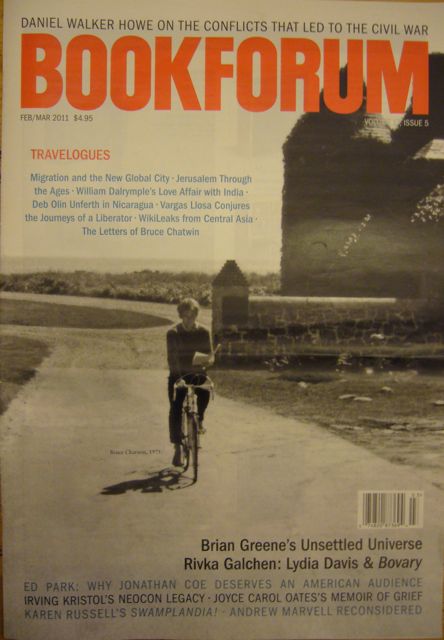
The recent publication of Bruce Chatwin’s letters in the volume entitled Under the Sun received subtantial coverage in at least two reviews, both of which also put Chatwin on the cover.

The cover of the TLS (29 Oct. 2010) features a beautiful photograph of Chatwin taken in 1982. He seems to be dressed for the outdoors, wearing what looks like a windbreaker, carrying a dark and heavy rucksack  on his shoulder and a pair of walking boots strung around his neck. He looks serious, focused, and, if not impatient with the photographer, at least as if his mind and body were almost somewhere else already. His body, filling the right-hand side of the picture, is moving out of the picture and into the light.

Bruce Chatwin on the cover of the 29 Oct. 2010 issue of the TLS (picture copyrighted to Snowdon/Vogue/Camera Press).

The cover of Bookforum (Feb./March 2011) shows Chatwin bicycling, the caption informs us, “on Fishers Island, NY, while absorbed in a book, 1975.” It, too, is a good photograph, less intimate and less structured than the above picture, but more humorous. It is slightly out of focus and this makes it difficult to tell whether his eyes are on the book or on the road, but he looks concentrated, and reading a book while riding a bicycle seems like the most natural thing in the world.

Bruce Chatwin on the cover of the Feb./March 2011 issue of Bookforum (picture copyrighted to Elizabeth Chatwin & Viking).

And yet, though I like both pictures, I wonder whether Chatwin is concentrating on his book or on his bike, and I wonder why he is wearing a windbreaker indoors and what he is wearing on his feet, or if he is wearing anything at all.

Posted in Bruce Chatwin | Tagged | Leave a comment

Truman Capote’s In Cold Blood

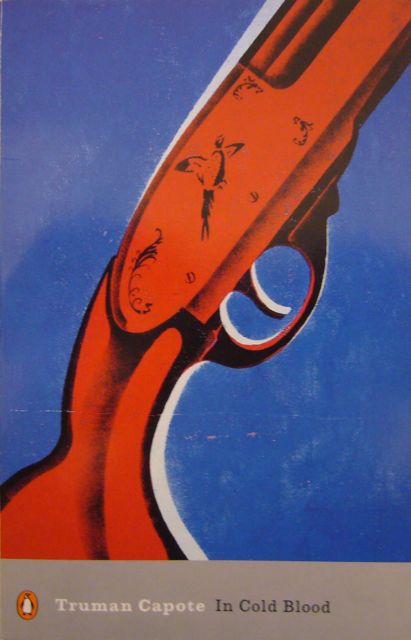
I recently came across this edition of Truman Capote’s In Cold Blood: A True Account of a Multiple Murder and Its Consequences, published by Random House. The beautiful cover was designed by S. Neil Fujita.

Truman Capote's In Cold Blood (New York: Random House, 1966)

The cover of the 2000 edition published by Penguin pales in comparison.

Truman Capote's In Cold Blood (London: Penguin, 2000)

The texts of both editions are, to the best of my knowledge, identical. But there is one difference that struck me: the Random House edition includes cropped photographs of the eyes of Eugene Hickok and Perry Smith, the killers of the Clutter family. They are positioned opposite the title page. No photographer is mentioned in the book.

The eyes of the killers Eugene Hickock and Perry Smith (from the Random House edition)

On seeing this, I was first reminded of the eyes that are to be found in Breton’s Nadja and throughout W.G. Sebald’s works. I wonder: why did Capote include these pictures? And why have they been omitted from later editions?

Posted in Uncategorized | Tagged , | Leave a comment

Novels with pictures in them?

It’s hard to know what to call, well, novels with pictures in them.

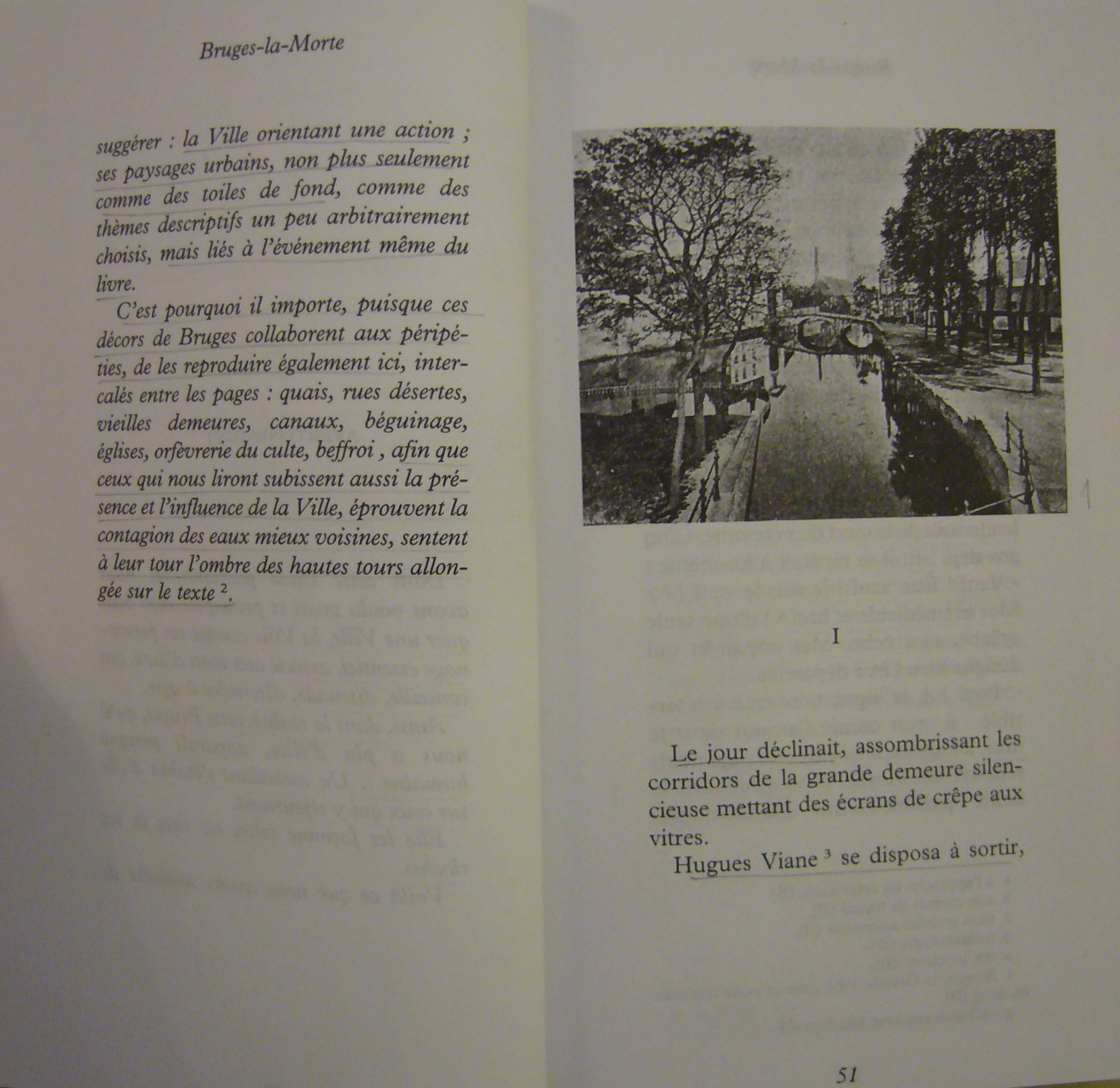
And yet, the first of these books was, it seems, published in 1892 by the Belgian writer Georges Rodenbach: his Bruges-la-Morte includes 35 pictures, mostly picture postcards of the streets and canals of Bruges.

The first photograph in G. Rodenbach's Bruges-la-Morte (from the 1998 edition published by Flammarion and edited by J.-P. Bertrand and D. Grojnowski.).

Since then, of course, a fair number of these books have been published, from André Breton’s Nadja and Virgina Woolf’s Orlando (both published in 1928) to the many such novels published in recent years: from Dave Eggers’ You Shall Know Our Velocity in 2002 to Jonathan Safran Foer’s Extremely Loud and Incredibly Close in 2005, and from Marianne Wiggins’ The Shadow Catcher in 2007 to Tim Pears’ Landed in 2010.

W.G. Sebald is no doubt to blame, as it were, for the resurgence of the genre (if it can be called a genre at all). The four novels he published during his lifetime – Vertigo (1990), The Emigrants (1992), The Rings of Saturn (1995) and Austerlitz (2001) – caught the attention of writers and critics as much as of scholars and publishers. However, Sebald was reluctant to call his books anything but “prose works”, a rather evasive and somewhat unhelpful description for this type of book.

Front cover of W.G. Sebald's Vertigo (London: Harvill Press, 1999).

The thing is, there is no agreement on what to call these works.  Wright Morris, who published The Home Place, for instance, in 1948, used the term “photo-text” to describe the books he created out of his own texts and photographs. On the other hand, Jack Finney’s Time and Again (1970) is promoted on the blurb as “the classic illustrated novel”, while Peter Delacorte’s Time on My Hands (1998) is subtitled “A Novel with Photographs”.

Scholars have variously referred to these works as “iconotexts” or “image-texts”, or have spoken more generally of “pictorial or visual fiction”. Alternatively, one might prefer speaking of “photography-embedded fiction”, the term chosen by Terry Pitts, who has written much that is interesting and informative on Sebald and on other similar works on his blog Vertigo.

I’m not quite sure what to make of all this. But in any case, this is one type of book I’m interested in and which I wish to write about on this blog. Having said this, I hope to write about other types of books too.

Posted in Picture novels | Tagged , , , , , , , , | 1 Comment