Japanese noir: David Peace’s Tokyo Year Zero

Published in 2007, David Peace’s Tokyo Year Zero, the first in a trilogy of novels, opens on 15 August 1945 with the discovery of a woman’s rotting corpse by one Detective Minami, minutes before Emperor Hirohito’s broadcast of Japan’s unconditional surrender. There follows a murky investigation into this and other brutal murders of young women in the dark and violent setting of post-war Tokyo, where no one is what they seem to be. The novel is based, Peace tells us in an author’s note, on a real case: one Kodaira Yoshio was executed in 1949 after confessing to the rapes and murders of ten women. Peace also lists many works of fiction and non-fiction, as well as films and music, on which he drew to write this novel.

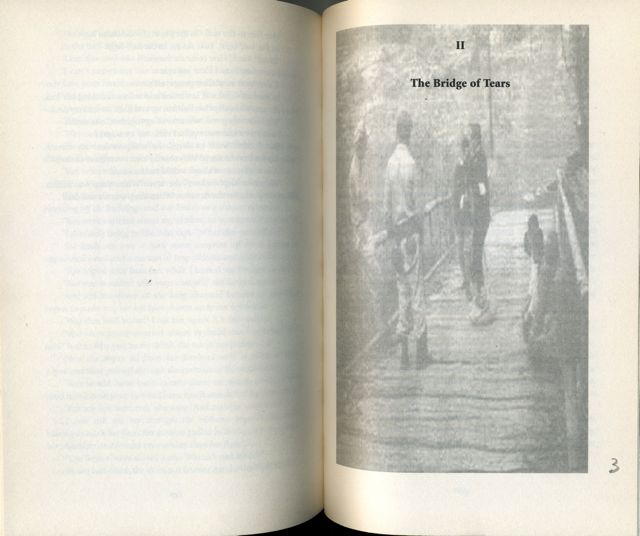
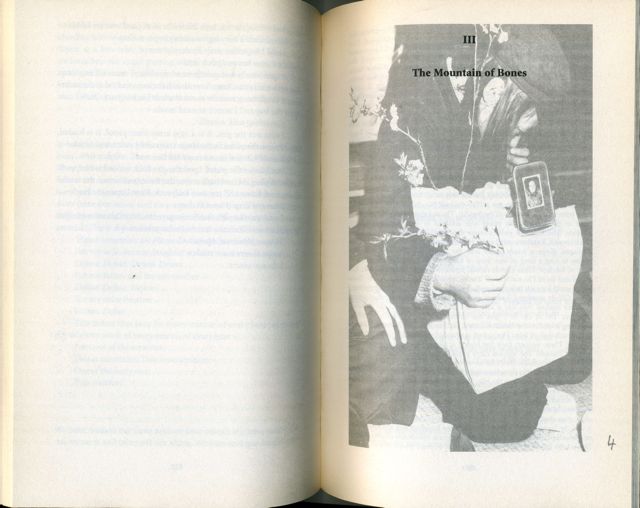
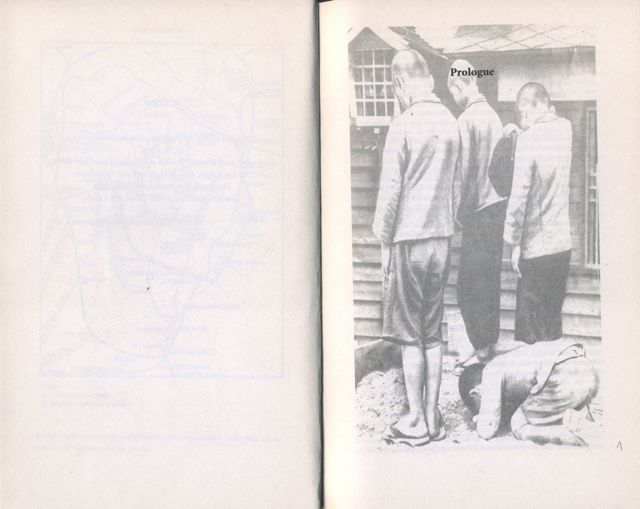
Perhaps it is because it is based on factual events that Peace decided to include four black-and-white photographs in the novel (the pictures below are from the 2008 paperback Faber edition). Only one of these pictures, however, the second,  is credited, to the American photographer Horace Bristol: it shows, it seems, a “pan pan streetwalker”. The other photographs show 1) three boys with their heads bowed down and one boy kneeling on the ground, 3) two (American?) soldiers (?) on a bridge looking at or expecting something from (?) two (?) people standing and one or two men (?) sitting on the bridge, and 4) a young girl (?) wearing a cap holding a portrait of her (?) mother (?).

It’s almost impossible to know what these photographs are really of, or where they were taken, or when, or who these people are, or what they are doing. Assuming that they are real or truthful (in the sense that they were taken in post-war Tokyo) this does not make their presence in the novel any clearer (which isn’t to say that I think they should have been removed). But the question remains as to what to do with them.

Although I don’t quite know what to do with them, I think they deserve at least to be mentioned. Indeed, I read through a number of reviews – accessed through the wonderful Complete Review – to see if I could find any information on these photographs or their role in the book, but I found nothing. More than that, of the following 11 reviews, not one of them even mentions the photographs: The Washington Post, The Village Voice, The Telegraph (two reviews), San Francicsco Chronicle, The Observer, New Statesman, The Independent, The Japan Times, The Scotsman, The Austin Chronicle. And when they are mentioned, they literally get little more than a passing mention: “Research has clearly been done: the book includes a useful map, photos and much savoury detail” (which is taken from a review in The Guardian).

This is in no way a critique or a reproach; it’s just another way of raising the question as to the place of photographs in fiction: why are they there if readers fail to see them?
Posted in David Peace, Picture novels | Tagged , , , , | 1 Comment

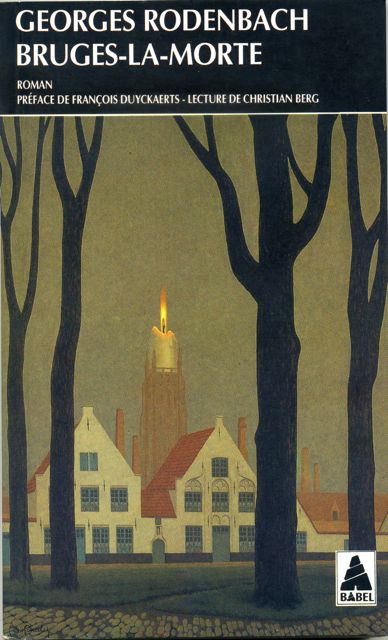
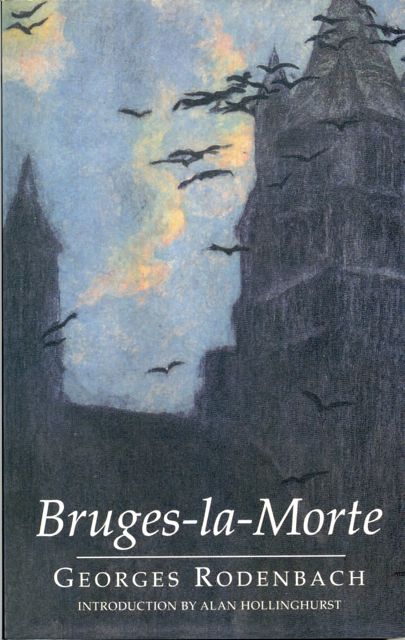
Three different editions of Georges Rodenbach’s Bruges-la-Morte

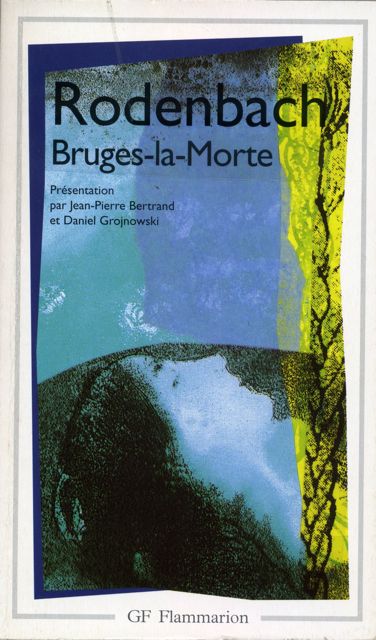
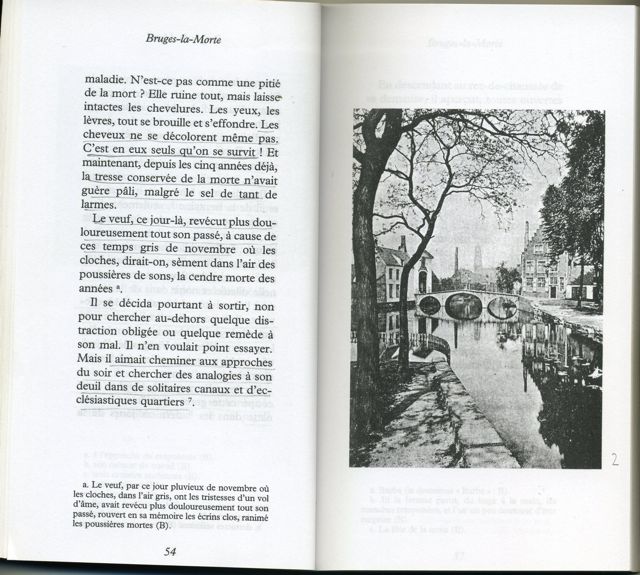
These three editions of Georges Rodenbach’s Bruges-la-Morte are in fact three very different books. The first edition, pictured left and dating from 1986, was published by Babel. The second edition, an English translation by Mike Mitchell, was published by Dedalus in 2005. And the third edition, pictured right, was published in 1998 by Flammarion.

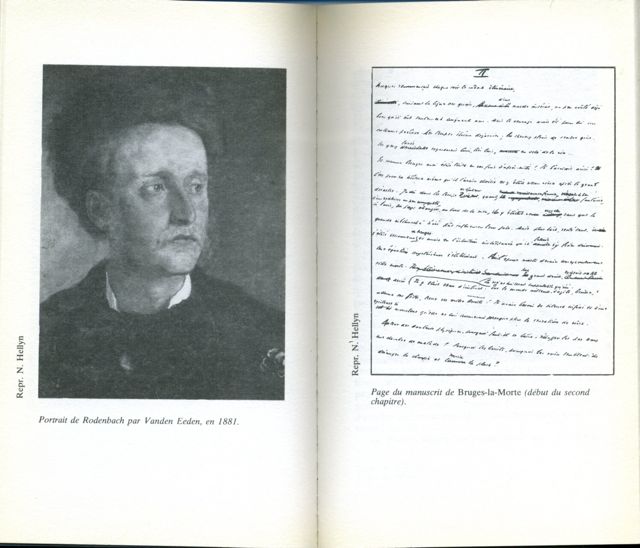
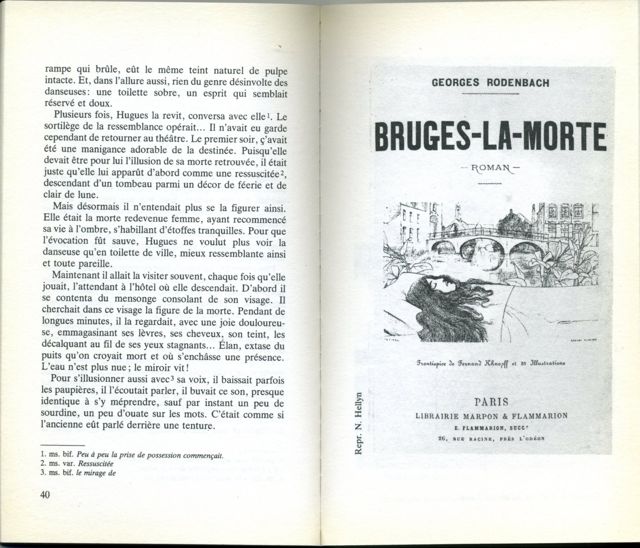
The Babel version, edited by Christian Berg, does not reproduce a single one of the 35 photographs reproduced in the original book version: his is a purely textual edition. Strangely enough, however, it does include eight pages of documents that are inserted, for some reason, in the middle of chapter four. Among these documents one finds, for instance, the pieces pictured below: a frontispiece by Fernand Khnopff for an edition by Flammarion, a portrait of the author, and a copy of a manuscript page. Strangely enough, the Babel edition does include the foreword by Rodenbach in which he notes that his intention is to evoke “the Town as an essential character, associated with states of mind, counselling, dissuading, inducing the hero to act”, and that he thus wanted his readers to feel the town’s influence, to “experience for themselves the shadow cast over the text by the tall towers” (I’m quoting from the Dedalus translation). Needless to say, readers will have to turn to another edition if they want to see the photographs chosen by Rodenbach.

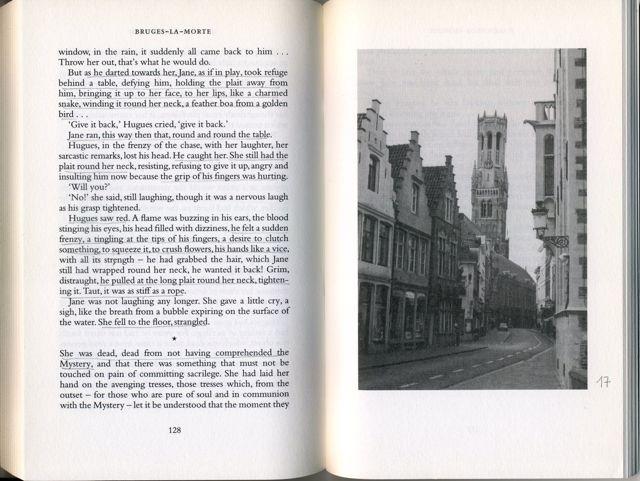
Mike Mitchell’s English translation, published by Dedalus (2005, rptd. 2007), includes none of the original photographs, but it does include a selection of recent photographs taken by Will Stone (who translated “The Death Throes of Towns”, an essay on Bruges by Rodenbach dating from 1888 and which is also included in the book): 17 photographs are to be found in the text of Bruges-la-Morte, and a further six in the text of “The Death Throes of Towns”. This decision, to include these contemporary photographs, was taken, Stone says, because it was thought this might be “more interesting” and that this might “stimulate debate”. Stone also notes that “despite the passing of time, it was clear that a number of those views to be found in the original images were being reproduced or at least ones which curiously evoked them”.

Although I’m opposed, on principle, to the idea of changing the pictures – they are as much a part of the book as the punctuation, say – it is in fact an interesting experiment  – although one which yields some anachronisms, given that some photographs feature cars – and it does stimulate debate. Paradoxically, however, it will only do so if readers are familiar with or have access to the original photographs: how else could readers compare the former with the latter? For that, readers must turn to the 1998 Flammarion version, edited by Jean-Pierre Bertrand and Daniel Grojnowski. Not only did they restore the original photographs to their proper place, but they also provide an informative introduction and much that is interesting in a “documentary file” at the end of the book.

Posted in Georges Rodenbach, Picture novels | Tagged , , , , | Leave a comment

The strange case of Simenon’s “phototext”

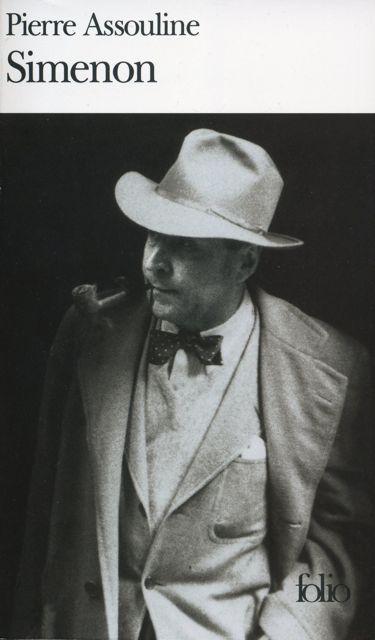
I have just read, with much pleasure, Simenon, Pierre Assouline’s remarkable 1992 biography of the creator of Inspector Maigret (Paris: Gallimard, 1996; at nearly 1,000 pages, the French edition is almost twice as long as either the US or UK editions, which total less than 500 and 400 pages, respectively). Of the many interesting things to be found in this volume, one was particularly so: indeed, I learned that Simenon published, in 1931, a 128-page “phototext” in collaboration with the German-born Germaine Krull, who contributed 104 black-and-white photographs.

La Folle d’Itteville – “The Madwoman from Itteville” – was meant to be the first in a series of illustrated detective novels published by Jacques Haumont, whose idea it was to launch the collection and with whom Simenon signed a four-book contract. The book failed to sell, however, and this was a first disappointment for Simenon. The second disappointment was the fact that Haumont had hired other writers to contribute other texts to his “phototext” collection, although Simenon had thought he was going to be the only author of the series. Haumont and Simenon fell out, and the “phototext” series was virtually stillborn.

Although the book has long been out of print – indeed, it doesn’t seem to have been reprinted since 1931 – second-hand copies are still available, though at a price, of course. These booksellers, for instance, have a copy for sale at close to €1,500. Whether interested in buying a copy or not, their website is worth visiting, however, since there are a few photographs of the book: the front cover, showing a woman lying, apparently, on the floor, with her head thrown back; two of Krull’s photographs, showing the cover woman being pushed, perhaps, to the ground by a man; and the back cover, which already featured an ad for the next volume in the series, also by Simenon and Krull, L’Affaire des 7′ – although that volume, of course, would never see the light of day.

Pierre Assouline's Simenon (Paris: Gallimard, 1996).

Posted in Georges Simenon, Germaine Krull, Photography, Picture novels | Tagged , , , , , | 1 Comment

Colum McCann’s feel-good fiction (and cheap use of photography)

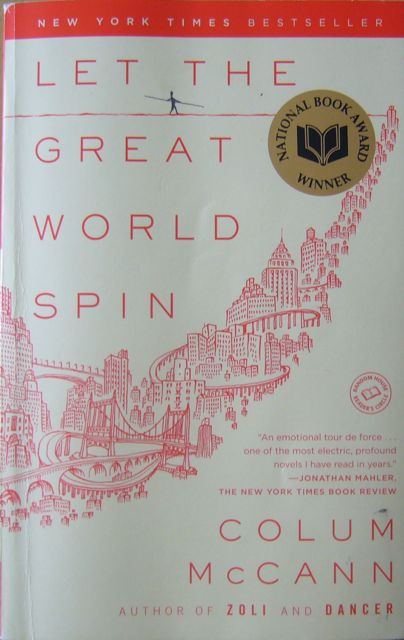
I was surprised to discover a photograph reproduced in Colum McCann’s award-winning Let the Great World Spin (2009), which I recently picked up in this second-hand Random House edition dating from 2010. The novel takes places on and around 7 August 1974, the day on which the French tightrope walker Philippe Petit crossed back and forth on a wire stretched between the twin towers of the newly built World Trade Center. This event is given marginal yet focused attention in three short sections, and serves as the backbone, as it were, to the entire novel: without it, the whole narrative would collapse in a flash.

The nine other sections set in 1974 focus on a range of characters: from a couple of working girls, as they’re called, in the Bronx to a couple of artists shuttling between the city and upstate New York, from a monk-like Irishman helping those girls in the Bronx to a Jewish/Waspish Upper East Side couple, and from the African-American mother of three boys killed in Vietnam to a young Hispanic photographer riding the subways photographing graffiti. All of these characters coexist too comfortably for my liking, to the extent that it all feels terribly unreal: this really is feel-good fiction.

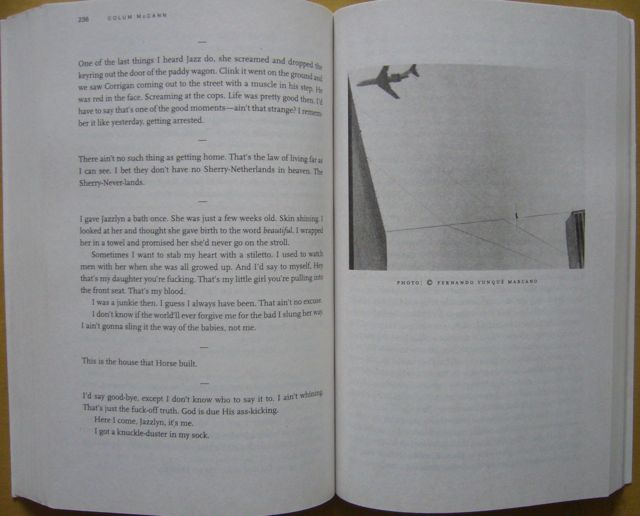
But to get back to the photograph, which is reproduced approximately two-thirds into the novel. Taken from the ground, apparently, it shows the microscopic tightrope walker on the wire stretched between the towers, while a plane is seen in the top-left corner, its nose close to the edge of one of the towers. It is, surprisingly, copyrighted to the young Hispanic photographer, Fernando Yunqué Marcano, whose name is given in the caption under the photograph. Although photographs in novels are sometimes said to have been taken by one or other character, this is the only case I know of where the fiction is pushed to include the copyright – a somewhat futile exercise, perhaps, since in his author’s note McCann tells us the photograph is by Vic DeLuca, Rex Images (copyright Rex USA).

No mention of the photograph is made in any of the sections set in 1974, nor is Marcano even shown taking the photograph: the last we see of him is when he leaves the subway station, following some policemen who are rushing to the scene of the crime.

The photograph is mentioned, however, at the start of the last section, set in October 2006. Although the reproduction shows no signs of being torn, it was discovered, we are told, “yellowing and torn” in a garage sale in San Francisco in 2002 by one of the prostitutes’ daughters, who is drawn to it, she says, because it was “taken on the same day her mother died” (she was killed with the Irishman in a car crash), and because of “the sheer fact that such beauty had occurred at the same time”, while the narrator adds: “A man high in the air while a plane disappears, it seems, into the edge of the building. One small scrap of history meeting a larger one. As if the walking man were somehow anticipating what would come later. The intrusion of time and history. The plane passes, the tightrope walker gets to the end of the wire. Things don’t fall apart”.

But for a novel set essentially in 1974, all this strikes me as unnecessary and unconvincing and forced: it shifts the focus from Petit (who is here literally too small to be seen in any way clearly) to the plane and hence to the 9/11 attacks, trivializing Petit’s action and hence trivializing the very backbone of the novel. It forces a connection that readers could hardly not be aware of: any mention of Philippe Petit or the World Trade Center before 9/11 will, for some years yet presumably, inevitably call up the 9/11 attacks, so why force the connection? It seems to me to be a cheap use of photography in this novel.

Posted in Colum McCann, Picture novels | Tagged , , , , , | 3 Comments

Robots from the Czech Republic

Who knew the term ‘robot’ came from the Czech ‘robota’, meaning ‘forced labour’? Not me. I only discovered this recently when I found this second-hand copy of Karel Čapek’s play R.U.R. (Rossum’s Universal Robots), which premiered 90 years ago, in 1921, and for which Čapek apparently coined the term. This tale of a robots’ revolt against their human masters is somewhat outdated, but still quite fun to read. This Penguin Classics edition features a translation by Claudia Novack and an introduction by  Czech novelist Ivan Klíma. The cover photograph, copyrighted to Bob Elsdale / Getty Images, is disappointing: it looks as if a computer chip and circuit board had been painted on the model’s skin and as if the batteries had just been glued to the back of his head.

Posted in Karel Čapek | Tagged , , | Leave a comment

Long gone are the days “when the world spoke French”

New York Review Books has just published When the World Spoke French by the French scholar and member of the Académie française Marc Fumaroli. This volume is a translation by Richard Howard of the somewhat more modestly titled Quand l’Europe parlait français, published in 2001 by Editions de Fallois. It focuses on an age when French was, as NYRB says, “the universal language of culture and intellectual life”. Indeed, “if you were a writer, thinker, or lover of la douceur de vivre (the sweetness of life) during the 18th century, you conversed and corresponded in French”, and in this volume, Fumaroli “presents a gallery of portraits of Europeans and Americans who conversed and corresponded in French, along with excerpts from their letters or other writings.”

It must surely make for interesting reading. And yet, when I saw this title advertised, I was reminded that the days when “the world” spoke French were long gone. Indeed, I’m often struck by the number of mistakes I come across in French quotes in English books. Here are just some examples from a number of books I read recently:

In his “Introduction” to Miss Julie and Other Plays (Oxford: Oxford UP, 1998), Michael Robinson speaks of Zola’s manifesto “La Naturalisme au théâtre” (when it should be “Le Naturalisme”).

In Curtis White’s novel Anarcho-Hindu: The Damned, Weird Book of Fate (Normal, IL: FC2, 1995), I came across “Bien sur, petit” (when it should be “Bien sûr“).

In Modernism: The Lure of Heresy (New York: Norton, 2008), Peter Gay writes that his visit to the Guggenheim Bilbao, “to borrow the highest praise the Guide Michelin has to offer, Vaux le voyage” (instead of  “vaut le voyage”). He also talks of Edouard Dujardin’s Les Lauriers sont coupés and his introduction of “monologues intérieures” (when it should be “intérieurs“), and Balzac is said to be the author of Les Illusions perdu (when it should be “perdues“).

In the English translation of Julían Ríos’ wonderful short story “Revelation on the Boulevard of Crime”, included in Best European Fiction 2010 (Champaign, IL: Dalkey Archive, 2010), I came across “Voilá le plaisir” (instead of “Voilà“).

In The Star Factory, Ciaran Carson quotes from Jean Cocteau’s Orphée: “L’oiseau chant avec ses doigts” (when it should be “chante“).

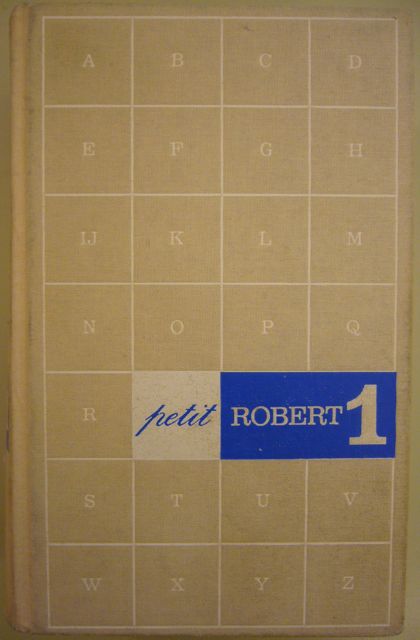
These are just some examples among many more I’ve come across over the years. So what’s to be done to remedy this sad situation, if anything? I don’t know. Perhaps someone should drop a line to President Sarkozy of France, or to the head of the Académie française (is it not Fumaroli himself?), or to Abdou Diouf, the Secretary General of the organization of French-speaking countries, La Francophonie. Perhaps it’s time they started distributing copies of the dictionary Le Petit Robert and the grammar Le Bescherelle to writers and publishers the world over if they don’t want la langue française to fall further into disuse.

Posted in French | Tagged , , , , , | 1 Comment

Judging a book by its cover?

This undated though relatively recent Vintage Classics edition of Richard Wright’s remarkable autobiography Black Boy: A Record of Childhood and Youth (1945) features a cover photograph credited to the Corbis company of an unidentified young black boy. Given that this is Wright’s autobiography, one might suppose that this would be a picture of the author himself as a child. However, this seems unlikely since the child isn’t identified as such and since the photograph is the property of Corbis and since the child doesn’t look like the adult Richard Wright. It seems strange that the publisher would choose a photograph that is not of the author to illustrate what is, after all, his autobiography.
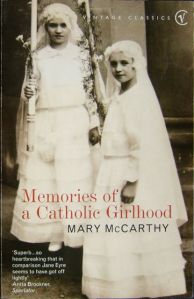
The same holds for this Vintage Classics edition published in 2000 of Mary McCarthy’s rather unremarkable memoir Memories of a Catholic Girlhood (1957): the cover photograph, showing two young girls in what must be their communion dresses, is credited to the Hulton Getty company and there is no indication as to who these people are, or whether one of them is McCarthy herself.

Does it matter whose picture is put on the cover? I think it does in the case of autobiographical works. I, for one, want to know whether the young boy or the young girl pictured here is the one whose story I’m reading. If not, who are these people? What’s their story? And who are these two girls? What are their stories?

The picture on the cover of Hugo Hamilton’s The Speckled People (2003) in this Harper Perennial edition from 2004 features a photograph, we are told on the back cover, “from the author’s private collection”: presumably of the author himself at a very young age (though, since we don’t actually get to see his face at all, it seems less important to have a picture of the author on the cover).

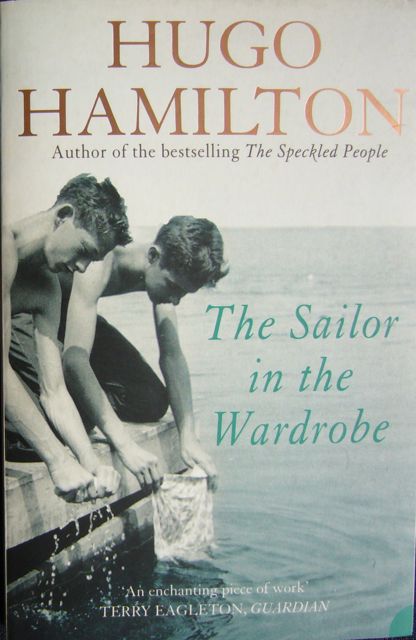
By contrast, the cover of the sequel to The Speckled People, Hamilton’s The Sailor in the Wardrobe (2006), also in a Harper Perennial edition, features a photograph showing two boys one might presume to be the author and a relative or friend; however, the caption on the back cover informs us that “the people in this image are not in any way related to any one of the people portrayed in this book”.

Out of curiosity, I checked whether Harper Perennial had an edition of Wright’s Black Boy and it turns out that they do. Here, too, they seem to have chosen the appropriate picture for the cover: the boy on the left-hand side (from our point of view) looks like the adult Wright and must indeed be him, probably standing next to his brother.

Posted in Autobiography, Richard Wright | Tagged , , , | Leave a comment

Hugo Claus and the most unread novel in Flanders

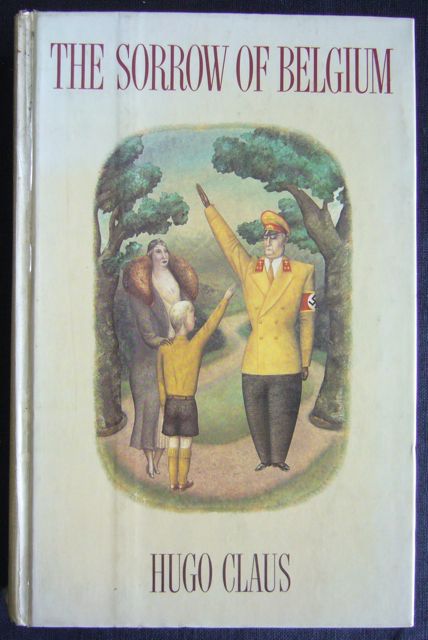
I recently came across this hardback edition of Hugo Claus’s The Sorrow of Belgium (1983) in the English translation by Arnold J. Pomerans published by Pantheon Books in 1990. I had already tried reading it a few years ago in the Penguin paperback edition, but failed to get beyond the opening pages. Since Claus (1929-2008) was, reputedly, the greatest Flemish writer and since this novel was, reputedly, his masterpiece, I somehow feel I will sooner or later have to give it another try.

Not least because I live in Brussels and because Belgium is going through a protracted political crisis and because the issue of collaboration during the Second World War has again come up in Parliament (see, e.g., this report on MSNBC). Incidentally, this cover illustration, apparently designed by Anne Scatto, has not been used since, to the best of my knowledge.

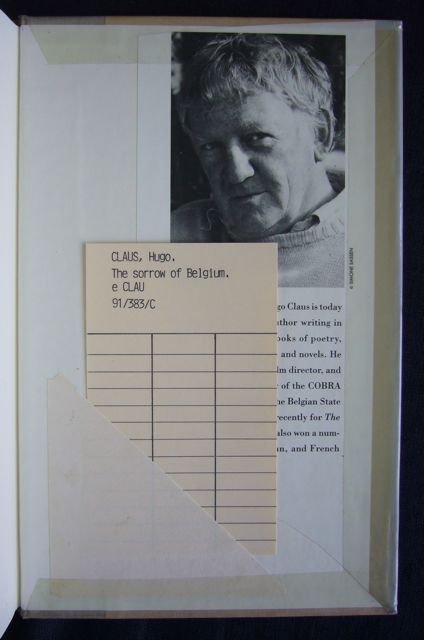
The copy I picked up  turned out to be a discarded library copy, and indeed, from the library card included at the back of the book, it seems as though not many English-speaking readers borrowed it in the twenty years it was sitting on the shelf in the public library in Dilbeek, a (Flemish) commune on the outskirts of the (billingual) Brussels region that came to fame a few years ago when it adopted the slogan “waar Vlamingen thuis zijn” (“where Flemings are at home”). Perhaps there are no English-speakers in Dilbeek, or if there are, perhaps they read Claus in Dutch, or perhaps they’re just not interested in Flemish literature, or in Claus’s work, despite the fact that he was often “tipped” for the Nobel Prize for Literature (surely a bad sign for any writer).

Or perhaps it’s just one of those “masterpieces” that no one ever gets around to reading. Indeed, if English-speakers in Dilbeek failed to delve into it, it also seems to have remained unread in Flanders: according to a 2005 survey by the Flemish broadcaster VRT (reported here in the Flemish newspaper Het Nieuwsblad), it was (and perhaps still is?) the most unread book in Flanders, ahead of Umberto Eco’s Foucault’s Pendulum and Salman Rushdie’s The Satanic Verses, the Bible and Joyce’s Ulysses.

Wait and see how long it will remain unread on my bookshelf.

Posted in Belgium, Hugo Claus | Tagged , | 1 Comment

Good PR, bad PR

Philip Roth's latest novel, Nemesis (London: Jonathan Cape, 2010).

It’s been over a week already, but I still don’t get it. One minute it is announced that Philip Roth has won the Man Booker International Prize for 2011. The next minute we learn that one of only three judges, Carmen Callil, has stepped down because, in a nutshell, she basically doesn’t think Roth deserves the award. Fair enough, but why stand down after the prize has been announced? And what was the chair, Rick Gekoski, doing during this time? Why didn’t he react sooner? I don’t understand. And what I find irritating is that the whole event ultimately has little or nothing to do with Roth’s work.

Roth certainly doesn’t need the award: I presume he needs neither the publicity nor the money. So I googled the various parties involved to see who might most be in need of some publicity. I think the results speak for themselves: “Carmen Callil” yields 136,000 results; “Virago Press” (the publishing house Callil founded in the seventies) gets 176,000 results; “Man Booker International Prize” totals 489,000 results; but the champion of them all is “Philip Roth”, with no less than 2,760,000 results.

While I was at it, I of course gave in to the temptation to google “thisissuperserious”. Here, too, the results speak for themselves: 49. Looks like I’m going to have to work on my own PR.

Posted in Philip Roth | Tagged , | 1 Comment

Posada Art Books has closed

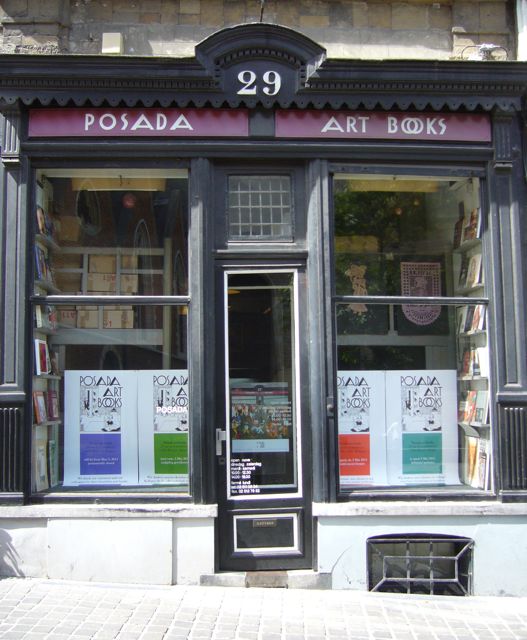
I knew it was coming, but I was sad to see that Posada, a bookshop in the centre of Brussels specializing in art books, had permanently closed its doors a few weeks ago already, on 3 May. Named after the Mexican cartoonist and artist José Guadalupe Posada, the shop had been run by the owners, Ada and Martijn Oleff, for more than 30  years. Their collection of books, which totalled more than 30,000 volumes, has been taken over by Librairie Michel Descours in Lyon.

For what it’s worth, Posada was ranked one of the ten most beautiful bookshops in the world by The Guardian in 2010. I say “for what’s it worth”, since these rankings are often pretty meaningless. But Posada certainly was beautiful, and one of the most special bookshops I’ve ever been in. I didn’t shop there often, since art books aren’t really my thing, but it was a real pleasure just to be able to browse there, and to know that such a place existed, a place that had been there for many years, that had not been renovated in as many years, that did not have to follow the latest trends, and that was run by people who cared about and knew their books so well.  It will be sadly missed.

On a more joyful note, one of Posada’s staff members will be opening a bookshop specializing in twentieth-century art in early September. More on that in due time.

Update: Laurent Bouchat was kind enough to update me on the new shop: Laurent Bouchat – Livres d’Art XXe siècle, 65 C rue de la Régence, 1000 Brussels. Open from Wednesday to Saturday, from 12:00 to 18:00. Check out the shop’s Facebook page. You can contact Laurent Bouchat at this e-mail address: laurentbouchat@gmail.com.

Posted in Bookshops, Brussels | Tagged , , | 3 Comments